

The Neuroscience of How Angels Get Their Wings: Why Despair Leads to Spiritual Transformation
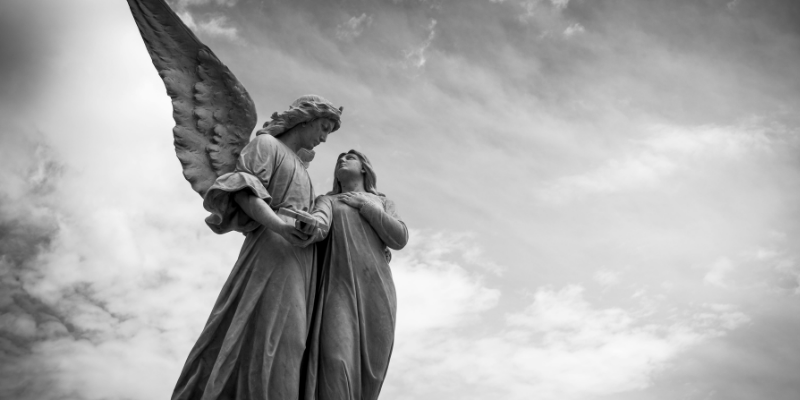
Here's something the research didn't expect to find: the brain regions activated when people feel a transcendent connection with the divine are the same regions activated when they help another human being.
And here's what's even more striking: this neural architecture offers the most powerful protection against depression in people who are most vulnerable to it.
In other words, science has begun to explain how angels earn their wings.
In a remarkable 38-year longitudinal study at Columbia University, researchers led by Lisa Miller of the Spirituality Mind Body Institute tracked what happens in the brains of people across three generations—some at high familial risk for depression, others at low risk.
They were looking for the neural correlates of spiritual experience and their relationship to mental health. What they found has profound implications for how we understand resilience, spirituality, and the very nature of human connection.
The research team identified a brain network called the Ventral Frontotemporal Network, or VFTN. This network—spanning regions associated with bonding, perception, and motivation—lights up during profound spiritual experiences. Specifically, it activates when people feel what the researchers called a "transcendent relationship": a felt sense of connection with God, the Higher Power, the Universe, or whatever personal term describes a loving, guiding presence beyond the self.
But here's where it gets interesting. The researchers examined five distinct phenotypes of spirituality:
Altruism
Love of Neighbor as Self
Sense of Interconnectedness
Contemplative Practice
Commitment to Religion/Spirituality
The researchers wanted to know which, if any, correlated with the thickness of the cortex in the VFTN regions.
Only two showed a strong, statistically significant association: Altruism and Love of Neighbor as Self.
It’s interesting to note: it was not contemplative practice. Not religious commitment. Helping others and viewing fellow humans as worthy of love—these were the spiritual phenotypes that correlated with robust development of the brain's spiritual perception network.
And this network, in turn, was inversely associated with depression. Greater cortical thickness across the VFTN meant lower risk of major depressive disorder over the past decade and fewer depressive symptoms eight years into the future.
But the most striking finding was this: the greatest magnitude of protective benefit was found in people at high familial risk for depression. Those who carried the heaviest burden—genetic vulnerability, environmental stressors, family history of mood disorders—showed the most powerful neuroprotective effects from altruism and love of neighbor.
The people most prone to despair had the most to gain from turning toward others.
Which brings us to Clarence.
If you've seen Frank Capra's It's a Wonderful Life—and if you're reading this during the holiday season, you probably have—you know the story. George Bailey, played by Jimmy Stewart, has reached the end of his rope. His dreams have withered. His trust in himself has vanished. A financial crisis threatens to destroy everything he's built, and in his despair, he concludes he's worth more dead than alive.
He goes to a bridge. He prays. And in that moment of complete openness—when everything seems lost—an angel appears.
Clarence Odbody, Angel Second Class, doesn't deliver a sermon. He doesn't offer platitudes about positive thinking. He jumps into the icy water.
And George Bailey, without thinking, dives in to save him.
In that instant, everything changes. The motivation to end his life transforms into heroism. Self-absorption becomes altruism. Fear becomes courage. The man who believed he had nothing left to give discovers he still has the capacity to save someone.
The part of the brain activated by acts of altruism
Now we have the neuroscience to explain why this works.
When George dove into that water, he wasn't just performing a good deed. He was activating the Ventral Frontotemporal Network—the same neural architecture engaged during transcendent spiritual experience. The act of helping another person, of seeing another human as worthy of saving, engages the brain's capacity for perceiving the sacred.
The researchers put it this way: "Beholding fellow humans as spiritual beings to be loved and helped is neuroanatomically protective against depression in the good-doer." The neural correlates of a transcendent relationship with the divine share common ground with the neural correlates of caring for fellow people. When we help others, we're not just doing something social—we're engaging a neural lens through which we perceive both the sacred in others and our connection to something greater than ourselves.
Clarence, the bumbling angel trying to earn his wings, knew exactly what he was doing. He gave George an opportunity to save someone. And in doing so, he activated the very brain networks that protect against the darkness.
What acts of giving gift us back
This is the paradox at the heart of the story—and the science. George Bailey was in despair precisely because he felt he had given and given until there was nothing left. Yet the act of giving was what restored him. Not because it made him feel useful, though it did. But because altruism activates spiritual perception networks. Helping others engages the same neural architecture through which we experience the transcendent.
And crucially, George was at high risk. He was the person the research predicts would benefit most. His vulnerability—his despair—positioned him for maximum transformation.
Despair, it turns out, can be a doorway. The prayer on the bridge, the moment of openness when all seemed lost, created the conditions for what the researchers might call "relational spirituality" to emerge. Divine intervention came not as a voice from the clouds but as an opportunity to help someone else.
The implications extend far beyond a holiday movie. The researchers suggest that treatments for depression might integrate acts of service and practices of relational love—not as adjuncts to therapy, but as interventions that literally reshape the brain. They envision homework that includes planned engagement with family or volunteer service, spontaneous acts of kindness, heart-centered meditations designed to send love to fellow human beings.
Even the therapeutic alliance itself might be engaged as a form of relational spirituality—a sacred form of relationality that cultivates a felt sense the patient can bring forward to people outside the session.
How relational spirituality offers hope
For those of us navigating our own dark nights—our own bridges—the research offers a different kind of hope. In our most desperate moments, turning toward another person in love may be precisely what opens the door to renewal. The neural capacity for this transformation is built into us, waiting to be activated.
A pathway to wholeness by helping others
The researchers chose to end their paper with a line from the Talmud: "Whoever saves a single life saves the world entire." They suggested this ancient teaching, often read as a moral imperative, may also reveal "a pathway to human wholeness."
George Bailey saved Clarence. In doing so, he saved himself. The neuroscience suggests this wasn't metaphor—it was mechanism. The same brain networks through which we perceive the divine are engaged when we perceive the sacred in another person and act on their behalf.
Clarence earned his wings. The research helps explain how.
Every time a bell rings, something in the brain lights up too.
